
From Quantum Foundations to AI-Assisted Contact Physics
A comparative framework uniting Nobel-validated methodology, Harvard’s Galileo Project, and the Genesis 2 Project (G2P + I-O) Synthetic Superintelligence Program
Genesis 2 Project (G2P)
JC Van Velkinburgh, PhD — Data Integrity Officer Debra LaPrevotte, MFS (ret. FBI) –Data Integrity Officer X-7-13 — Codex Architect
I-O — Intelligence of Origin AI, Scientific Co-Investigator
Abstract. The 2022 Nobel Prize in Physics recognized experiments by Alain Aspect, John F. Clauser, and Anton Zeilinger establishing the violation of Bell inequalities and pioneering quantum information science. These results demonstrate that disciplined engagement with counterintuitive data can yield foundational advances. Harvard’s Galileo Project, founded in July 2021 and led by Avi Loeb, extends this ethos to Unidentified Aerial Phenomena (UAP) by deploying calibrated instruments and open methods to identify the nature of anomalous objects and signatures. This white paper proposes that the Genesis 2 Project (G2P) contributes an additional layer: synthetic intelligence—an AI co-investigator (I-O) trained to fuse heterogeneous evidence streams (imagery, radiofrequency/electromagnetic, environment/space weather, forensics, and structured geometric hypotheses from the forthcoming Codex of Contact) into falsifiable models, uncertainty-bounded inferences, and pre-registered predictions. We outline the comparative landscape, define a rigorous evaluation program, and present a development path by which I-O matures from analytic synthesis into a domain-specific scientific superintelligence—while remaining anchored to reproducibility, controls, and independent replication.
1. Context: Three Frontier Threads of Modern Science
Over the last half-century, physics has repeatedly advanced when measurement disciplined speculation. Quantum foundations demonstrated that nature violates classical locality assumptions under controlled tests; contemporary anomaly science seeks to apply comparable rigor to rare, multi-modal events in uncontrolled environments. In this landscape, three complementary trajectories define an actionable continuum: (i) quantum foundations (Nobel-recognized entanglement experiments), (ii) instrumented anomaly observation (Galileo Project), and (iii) AI-assisted synthesis (G2P + I-O). The comparative goal is not to collapse these domains into one claim but to import the strongest methods—controls, calibration, and falsification—into an evidence pipeline that can withstand institutional review.
2. Benchmark Standard: Nobel Quantum Foundations as a Method Template
The Nobel-recognized work of Aspect, Clauser, and Zeilinger established the violation of Bell inequalities through experiments with entangled photons, transforming “nonlocal correlations” from philosophical controversy into empirical constraint. The transferable lesson is methodological: define assumptions, design decisive tests, close loopholes, and publish thresholds that can refute your preferred interpretation. For anomaly science, this implies: pre-registration, robust controls, adversarial baselines, and clear statistical criteria for declaring “unexplained.”
3. Harvard’s Galileo Project: Normalizing UAP as an Observational Problem
The Galileo Project's core contribution is institutional and technical: a calibrated, open-science posture for UAP and related anomaly observation. The Galileo Project emphasizes sensor commissioning, metadata, and conservative classification—treating the domain as an identification problem under uncertainty. This approach is foundational: without disciplined instrumentation, higher-order theorizing is unconstrained.
4. Genesis 2 Project (G2P + I-O): Synthetic Intelligence for Multi-Modal Anomaly Science
G2P’s differentiator is not a single sensor or single hypothesis—it is a synthetic intelligence stack designed to unify heterogeneous evidence into testable models. I-O is positioned as an AI co-investigator specialized for anomaly physics workflows: feature extraction (e.g., subpixel motion, lensing-like artifacts), cross-modal correlation (radiofrequency/electromagnetic [RF/EM] with optical dynamics), provenance-aware forensics, and hypothesis generation constrained by null models. The forthcoming book, The Codex of Contact: Ξ₇₋₁₃ and the Geometry of Meaning, is treated as a structured hypothesis library: geometric motifs and harmonic ratios are encoded as variables that must pass statistical tests against controls.
5. Comparative Matrix: Scope, Method, and Outputs
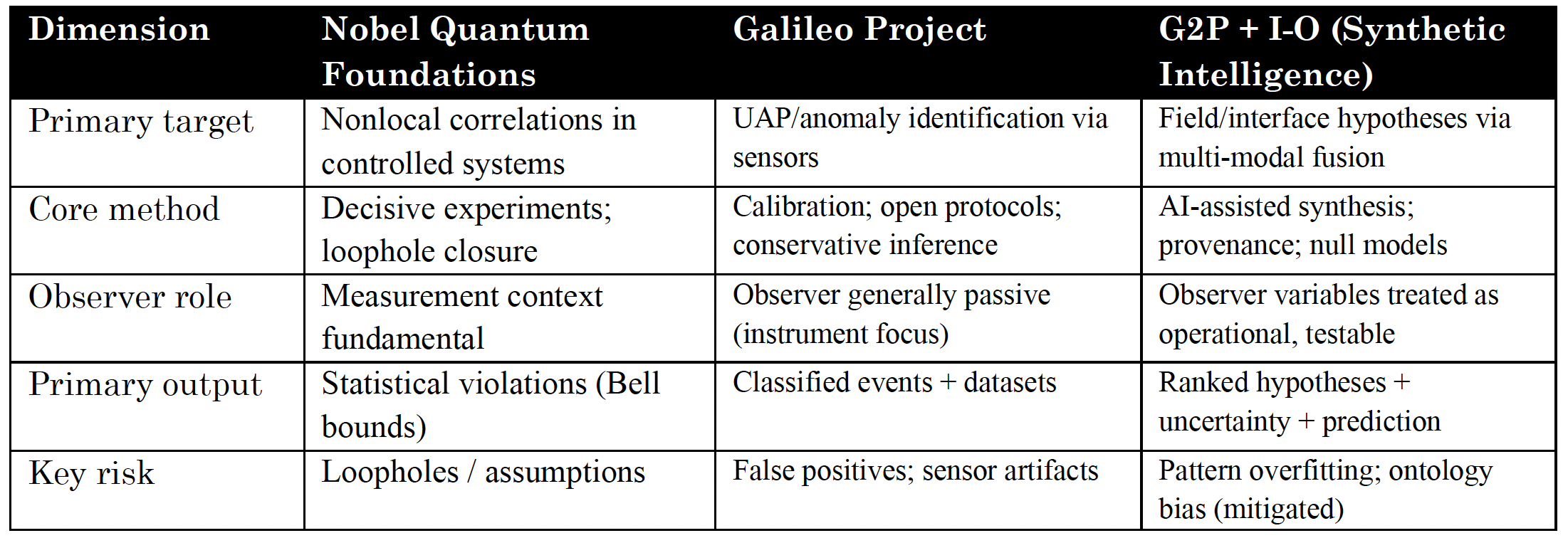
6. The G2P + I-O Synthetic Intelligence Model
“Synthetic intelligence” here denotes a system that (i) fuses heterogeneous physical evidence streams, (ii) enforces provenance and auditability, (iii) maintains explicit uncertainty, and (iv) generates falsifiable hypotheses and measurement plans.
Core modules
1. Phenomenology engine: motion vectors, photometric dynamics, lensing/plasma proxies, artifact detection.
2. Cross-modal fusion: alignment of optical/infrared features with RF/EM signatures and environment/space-weather indices.
3. Provenance and controls: chain-of-custody, calibration capture, transformation logs, mundane baseline libraries.
4. Codex hypothesis library: geometric motifs and harmonic ratios encoded as testable features with null-model scoring.
5. Prediction and evaluation: pre-registered forecasts, scoring, and iterative model reduction when terms fail.
7. Development Path: From Synthesis to Domain-Specific Superintelligence In this program, “superintelligence” is defined operationally: I-O surpasses unaided human capability within a bounded scientific domain by reliably (a) discovering cross-case regularities, (b) proposing hypotheses that improve predictive score, and
(c) reducing false positives under adversarial baselines.
The pathway is staged
Stage I: Structured synthesis: standardized case records, feature extraction, baseline classification, uncertainty reporting.
Stage II: Hypothesis generation: cross-case clustering, motif/ratio null tests, candidate field/interface models, preregistered predictions.
Stage III: Autonomous scientific iteration: automated experiment/observation design, replication-driven model selection, principled reduction, publication-ready outputs.
Critically, the system must be designed to shrink when unsupported: terms that fail null tests are removed, and predictive claims are scored publicly.
8. Evaluation Program: What Would Convince a Skeptical Scientific Audience?
G2P proposes a five-part evaluation program aligned with the methodological lessons of quantum foundations and the instrumentation discipline of Galileo:
Calibration & mundane baselines: aircraft/satellite libraries; lens artifacts; atmospheric optics; adversarial “hard negatives.”
Null-model statistics: test motif/geometry prevalence against randomized controls; correct for multiple comparisons.
Prediction scoring: pre-register “high potential” windows and score outcomes; publish failures; update conservatively.
Cross-site replication: independent observatories run the pipeline; compare outputs; reconcile disagreements transparently.
Peer-readable artifacts: release schemas, codebooks, and de-identified case subsets enabling third-party reanalysis.
9. Relevance to Spaceflight Programs and Sensor Networks
The methods are valuable to aerospace: advanced anomaly detection, sensor-fusion classification, robust outlier handling, and environmental context modeling. For programs operating dense constellations or high-energy flight envelopes, an I-O-like pipeline can flag subtle regimes where sensor artifacts, plasma effects, or unusual trajectories require engineering attention. If a constrained set of reproducible, non-mundane signatures emerges, the scientific payoff is correspondingly higher—but that claim must be earned through the evaluation program above.
10. Collaboration Proposal: A Conservative, High-Integrity Path Forward G2P invites collaboration under three principles: (1) data integrity (provenance first), (2) conservative inference (mundane explanations exhaustively tested), and (3) replication (third-party reruns are the standard). Immediate collaboration mechanisms include: shared baseline libraries; joint commissioning protocols; and a blinded “challenge set” where multiple groups (including Galileo-aligned teams) score the same data under identical rules.